
What to Do When Someone Dies: A Practical UK Checklist (England & Wales)
When someone dies, it’s hard to know what to do first. There can suddenly seem to be an enormous number of things to organise.
Registering the death. Finding the will. Arranging the funeral. Contacting banks. Cancelling accounts. Dealing with pensions, property, bills and tax. And, potentially, applying for probate.
You don’t need to do everything immediately.
This checklist explains what usually needs to happen, roughly in the order you’ll deal with it, so you can concentrate on the important things first.
This guide covers England and Wales. Scotland and Northern Ireland have different processes for registering deaths and administering estates.
The short version: what to do when someone dies
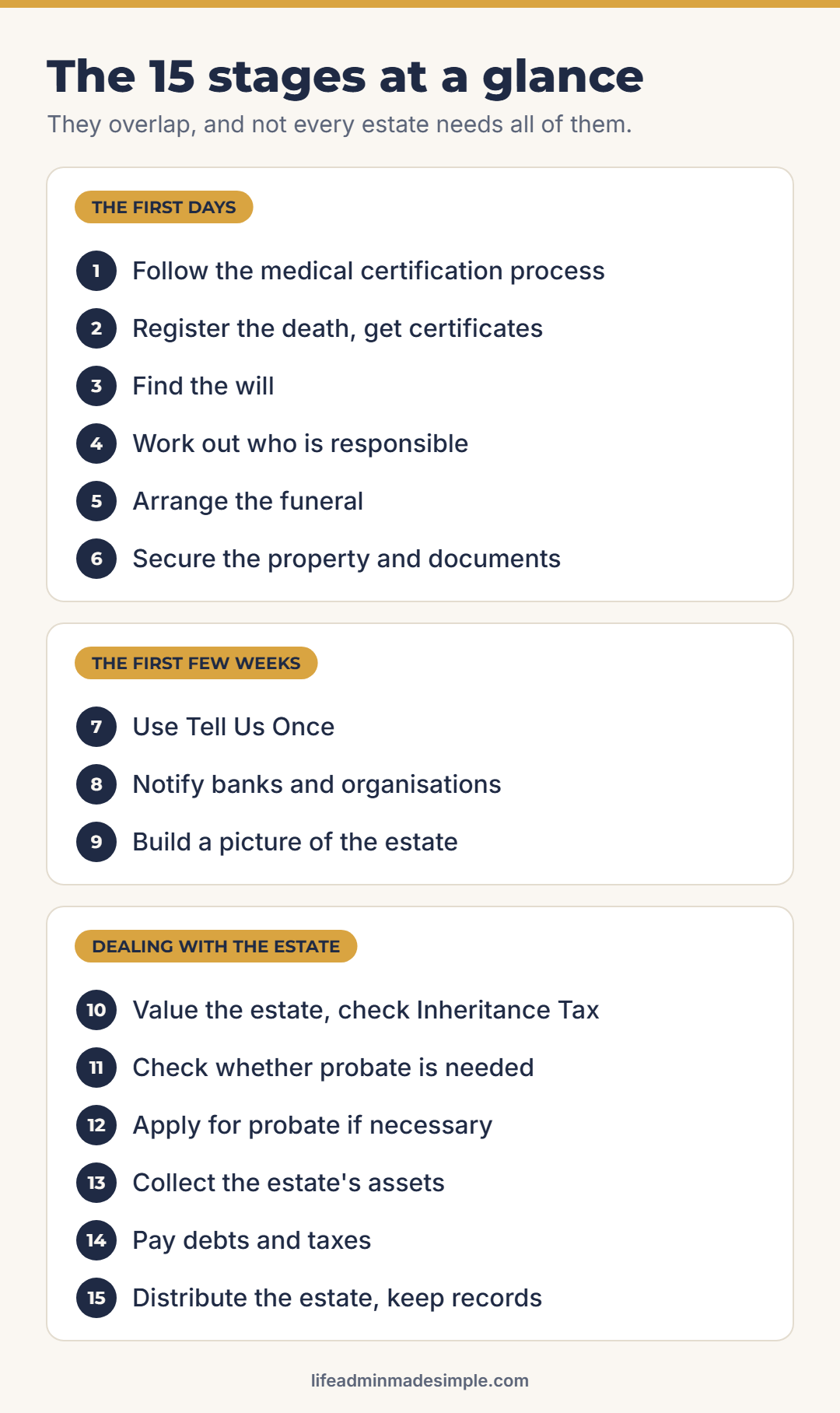
If you just need to know where to start, these are the main stages. Each one matches a section below.
- Follow the medical certification process.
- Register the death and get death certificates.
- Find the will, if there is one.
- Work out who is responsible for the estate.
- Arrange the funeral.
- Secure the property and important documents.
- Use Tell Us Once to notify government organisations.
- Notify banks, insurers, pension providers and other organisations.
- Build a picture of the estate: assets, debts and commitments.
- Value the estate and check the Inheritance Tax position.
- Check whether probate is actually needed.
- Apply for probate if necessary.
- Collect the estate’s assets.
- Pay debts and taxes.
- Distribute the estate and keep records.
Some of these stages overlap, and not every estate needs all of them. What matters is working through the administration methodically rather than trying to deal with everything at once.
Make the administration easier
The hard part of dealing with an estate is rarely any single task. It’s keeping track of dozens of small ones.
Which banks have been contacted? Who needs a death certificate? Has the pension provider replied? Which subscriptions still need cancelling? What’s been valued? What documents are still missing?
That’s why we created The First 14 Days, a free checklist for England and Wales. It gives you one place to record what needs doing in those first two weeks and work through it step by step.
No complicated legal language. Just a practical starting point for getting the administration under control.
If you’re the executor and want to keep track of the whole estate, the Estate Asset Register and Executor Starter Bundle pick up where the checklist leaves off.
1. Follow the medical certification process
What happens immediately after the death depends partly on where the person died and the circumstances.
Where the death follows medical care, a doctor will confirm the death and the medical examiner process takes place before you can register it. The medical examiner is an independent senior doctor who reviews the proposed cause of death. Their office will tell you when you can register.
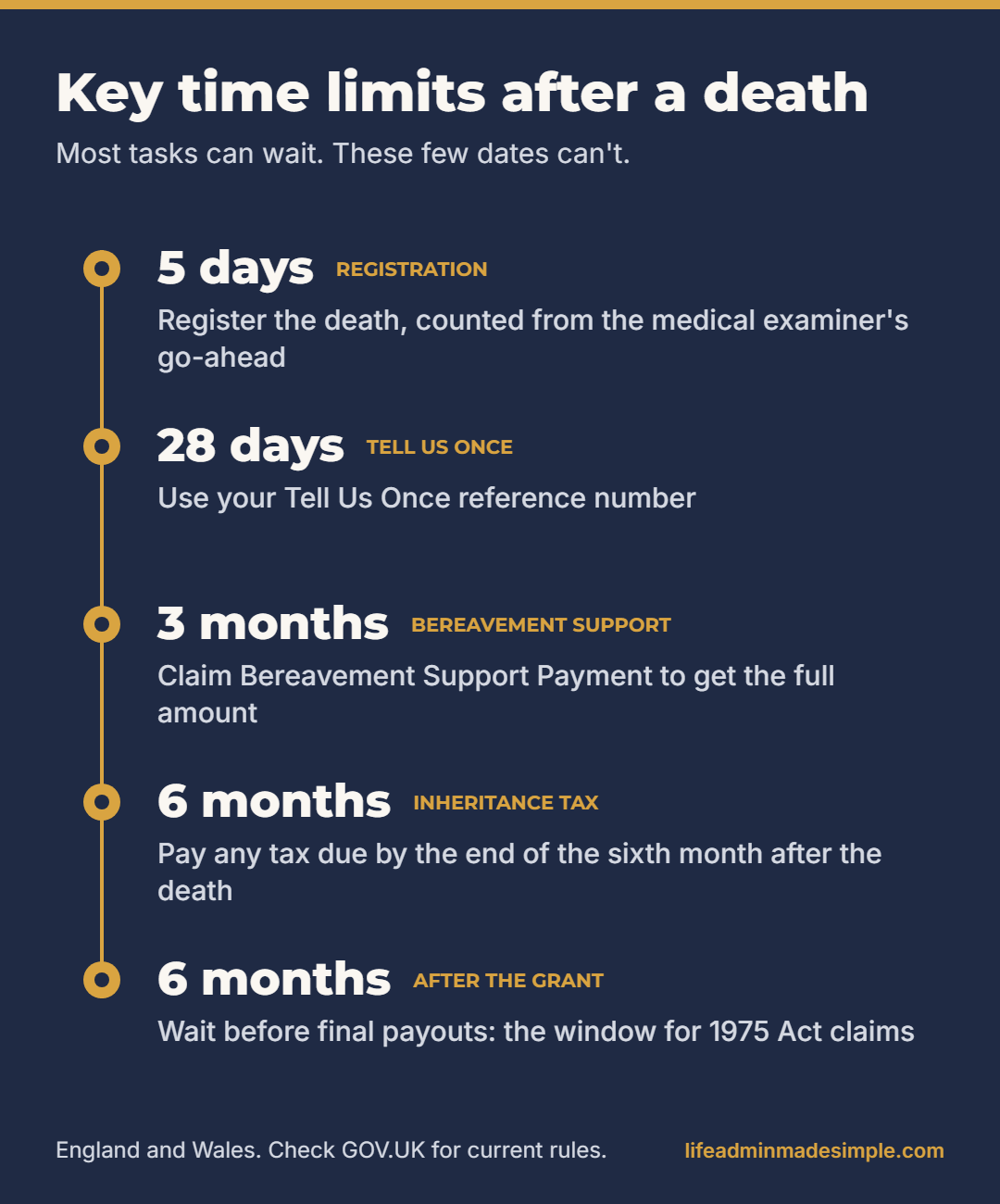
In England and Wales, you should register the death within five days of the medical examiner’s office confirming that you can. Weekends and bank holidays count towards those five days.
If a coroner is involved
A death may be referred to a coroner where, for example, the cause is unknown or the circumstances need further investigation. Registration may then be delayed.
If an inquest is needed, the coroner can issue an interim death certificate. Many organisations will accept it while you wait for the final certificate, so you don’t have to wait for the inquest to finish before starting the practical administration.
2. Register the death and get death certificates
Once you’ve been told the death can be registered, contact the register office for the area where the person died. Our guide to registering a death in England and Wales walks through the appointment, who can register and what to bring.
After registration you can buy official death certificates. A few certified copies are useful because banks, pension providers and insurers may want evidence of the death. Don’t automatically buy a large number, though. Many organisations now accept digital notification, return certificates after checking them, or use verification services.
You’ll also receive the paperwork needed for burial or cremation, often called the green form. Where a coroner is involved, the coroner deals with this instead.
3. Find the will
Try to establish early whether the person left a will. Look among their important papers and check whether a solicitor, will-writing service or bank holds the original. Don’t assume a photocopy you find at home is the latest version. If you can’t find a will, the National Will Register run by Certainty can search for one registered with it, for a fee.
The will tells you:
- who the executors are;
- who should inherit the estate;
- whether there are any specific gifts;
- whether trusts have been created; and
- sometimes, the person’s funeral wishes.
If probate is required, you’ll need the original will for the application.
What if there is no will?
If someone dies without a valid will, they have died intestate. There’s no executor. Instead, an eligible person, usually a close relative, can apply to become the administrator of the estate, and the law decides who inherits.
One result catches many families out. An unmarried partner inherits nothing under the intestacy rules, however long the relationship lasted. A partner left without provision may be able to make a claim against the estate under the Inheritance (Provision for Family and Dependants) Act 1975, but that’s a legal claim, not an automatic right. Get advice quickly if this applies to you.
4. Work out who is responsible for the estate
If there’s a will, check who has been named as executor. If there’s no will, the person legally entitled to deal with the estate can apply to become the administrator. Executors and administrators are together called personal representatives.
Personal representatives are legally responsible for dealing properly with the deceased person’s money, property and possessions until the estate has been fully administered.
Being an executor doesn’t mean you have to do everything yourself. You can get professional help with part or all of it.
5. Arrange the funeral
The funeral can be arranged while the other administration is getting started. Before committing to significant costs, check whether:
- the deceased left funeral instructions;
- a prepaid funeral plan exists;
- there’s relevant life insurance;
- money has already been set aside for funeral costs; or
- the estate has enough funds.
You may not have to pay the funeral bill yourself. Most banks and building societies will pay the funeral director’s invoice directly from the deceased person’s account, even before probate, if there’s enough money in it. Ask the bank’s bereavement team.
If you get certain benefits and are responsible for the funeral, you may be able to claim a Funeral Expenses Payment from the government. You have six months from the funeral to claim.
Keep every invoice and receipt. Reasonable funeral costs can be deducted from the estate when working out Inheritance Tax.
6. Secure the property and important documents
If the person lived alone, make sure their home and possessions are secure. You may need to:
- locate keys;
- check doors and windows;
- redirect post;
- notify the home insurer;
- keep the heating on low in cold weather;
- look after pets;
- secure vehicles;
- gather important paperwork; and
- make a basic record of valuable possessions.
Tell the home insurer straight away that the policyholder has died, particularly if the property will be empty. Many policies restrict cover once a home has been unoccupied for around 30 days, and some require regular inspections.
Don’t give away or dispose of possessions until you understand the will and the estate.
7. Use Tell Us Once
When you register the death, the registrar will usually explain the government’s Tell Us Once service. It lets you report the death to several government organisations in one go. Depending on the person’s circumstances, this can include:
- benefits;
- State Pension;
- HMRC;
- passports;
- driving licences;
- local council services; and
- certain public-sector pensions.
The registrar may complete Tell Us Once with you or give you a unique reference number to use yourself. That reference has to be used within 28 days.
Tell Us Once doesn’t reach private companies, so you’ll still need to contact banks, utilities and the rest separately.
Check whether you can claim Bereavement Support Payment
If your husband, wife or civil partner has died and you’re under State Pension age, you may be entitled to Bereavement Support Payment. Some cohabiting partners with children can now claim too. Claim within three months of the death to get the full amount; claims made later receive less.
8. Notify other organisations
Start a list of the organisations connected with the person who died. Common examples include:
Money and property
- Banks and building societies
- Mortgage providers
- Credit card companies
- Investment providers
- Premium Bonds and NS&I
- Pension providers
- Life insurance companies
- Landlords or letting agents
Household
- Electricity and gas
- Water
- Broadband and mobile phone
- TV and streaming services
- Home insurance
- Council Tax
Other organisations
- Employer
- Professional bodies
- Clubs and memberships
- Charities receiving regular donations
- Subscriptions and online accounts
For banks, the free Death Notification Service lets you notify several participating banks and building societies with a single form.
Don’t rush to close everything. Home insurance, utilities and anything connected with the property may need to stay in place while the estate is administered. Record each organisation and find out what needs to happen with it.
9. Build a picture of the estate
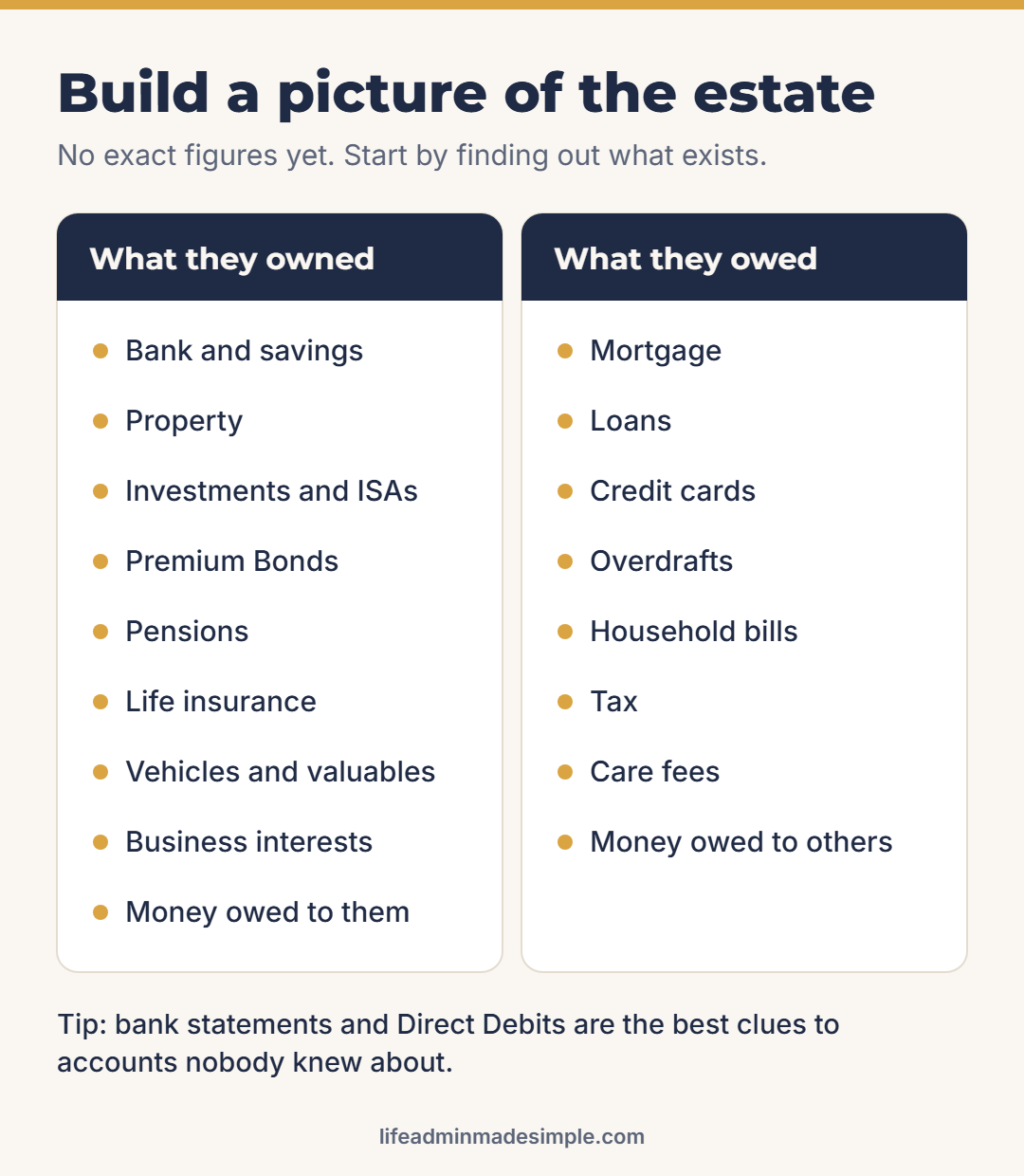
Before you can deal with probate, you need to know what the person owned and what they owed. Start an inventory.
Assets might include:
- Current and savings accounts
- Property
- Investments, shares and ISAs
- Premium Bonds
- Pensions with death benefits
- Life insurance
- Vehicles
- Valuable possessions
- Business interests
- Money owed to the deceased
- Overseas assets
Liabilities might include:
- Mortgages
- Loans and credit cards
- Overdrafts
- Household bills
- Tax
- Care fees
- Money owed to other people
You don’t need exact figures yet. The first goal is knowing what exists. Bank statements, emails, tax records and regular Direct Debits are the best clues to accounts and commitments you didn’t know about.
10. Value the estate and check the Inheritance Tax position
Before applying for probate, you’ll need to value the estate: the deceased person’s assets, minus their debts. You may need professional valuations for property, investments, valuable possessions and business interests.
You then need to work out whether Inheritance Tax is due. Every estate has a tax-free threshold (the nil-rate band) of £325,000. An extra residence nil-rate band of up to £175,000 can apply where a home passes to children or grandchildren. Anything left to a husband, wife or civil partner is generally exempt, and unused allowances can often pass to the surviving spouse. Check the current thresholds on GOV.UK, as they can change.
Even where no tax is due, you’ll still need the estate values for the probate application.
The Inheritance Tax deadline
This is the deadline that catches executors out. Any Inheritance Tax due must be paid by the end of the sixth month after the death. HMRC charges interest after that. Most of it usually has to be paid before the probate grant is issued, so you may need to pay tax before you can access the estate’s money. Banks can often pay Inheritance Tax directly to HMRC from the deceased’s accounts, and tax on property can sometimes be paid in instalments.
If you have to send a full Inheritance Tax account (form IHT400) to HMRC, you must wait 20 working days after sending it before you can apply for probate.
Pensions and Inheritance Tax from April 2027
For deaths on or after 6 April 2027, most unused pension funds and pension death benefits will count as part of the estate for Inheritance Tax. Personal representatives will be responsible for reporting them and, in many cases, for paying the tax. Death-in-service benefits are excluded. If the person had significant pension savings, this can change the tax position considerably, so take advice.
More complicated estates, for example those involving trusts, significant lifetime gifts, businesses or overseas assets, may justify professional advice.
11. Check whether probate is actually needed
Probate is often discussed as though every executor needs it. That isn’t the case.
In England and Wales, probate is the legal authority to deal with certain assets in an estate. Whether you need it depends on what the person owned and on the rules of the organisations holding those assets.
For example, you may not need probate for jointly owned assets that pass automatically to the surviving owner, or where a bank is willing to release a small balance without it. Each institution sets its own limit. If the person owned a house or flat in their sole name, you’ll almost always need it.
So don’t apply simply because someone has died. Find out first whether the estate needs it.
12. Apply for probate if necessary
Where there’s a valid will, an executor applies for a Grant of Probate. Where there’s no will, the appropriate person applies for Letters of Administration.
Before applying, you’ll need to:
- confirm who is entitled to apply;
- value the estate;
- work out the Inheritance Tax position; and
- complete any HMRC forms and pay any tax due before the grant.
You can apply online or by post, and there’s an application fee. Check the current fee on GOV.UK before you apply.
Many straightforward estates are handled without a solicitor, although professional help makes sense for complicated estates or where family members or beneficiaries disagree.
13. Collect the estate’s assets
Once you have the authority you need, you can start collecting or transferring assets. This might involve:
- closing bank accounts;
- transferring or selling investments;
- claiming life insurance;
- selling or transferring property; and
- collecting money owed to the deceased.
Keep estate money separate from your own, ideally in a dedicated executor account. And keep records. An executor should be able to show where every pound came from, where it went and why.
14. Pay debts and taxes
The deceased person’s debts don’t become the executor’s personal debts. They’re liabilities of the estate.
But an executor can become personally liable by paying out to beneficiaries before settling the estate’s debts. Before distributing anything, make sure you’ve dealt with:
- outstanding household bills;
- loans and credit cards;
- mortgages;
- funeral costs;
- the deceased’s Income Tax up to the date of death, including any final tax return HMRC asks for;
- Inheritance Tax, where due;
- administration expenses; and
- any other legitimate debts.
The estate can also owe Income Tax or Capital Gains Tax on income or gains made while it’s being administered.
Protect yourself from unknown creditors
You can’t pay a debt you don’t know about. To protect yourself, place a statutory notice to creditors (known as a Section 27 notice) in The Gazette and a local newspaper. Creditors then have at least two months to come forward. If you distribute the estate after that period, you’re protected from personal liability for debts nobody claimed.
15. Distribute the estate and keep records
Once the assets are collected and the debts, taxes and expenses are paid, the rest of the estate can be distributed. If there’s a valid will, follow it. If not, follow the intestacy rules.
Consider waiting six months from the date of the grant before final distribution. That’s the period in which a claim can be brought under the Inheritance (Provision for Family and Dependants) Act 1975, for example by a partner or dependant who feels they weren’t reasonably provided for. Distributing earlier can leave you exposed if a claim is made.
Before paying anyone, run a bankruptcy search against each beneficiary with the Land Charges Department. It’s quick and cheap. If a beneficiary is bankrupt, their share may belong to their trustee in bankruptcy, and paying them directly can leave you liable.
Before the final payments, prepare clear estate accounts showing:
Money coming into the estate
minus debts, tax and administration costs
equals the amount available for beneficiaries.
Ask beneficiaries to sign to approve the accounts and confirm receipt of their share. Keep the estate records afterwards. HMRC can raise questions years later.
Things you do NOT need to do immediately
One of the easiest mistakes after a death is treating every task as urgent. Most aren’t. You don’t need to immediately:
- apply for probate;
- close every bank account;
- cancel every household service;
- clear the person’s home;
- sell property;
- distribute possessions;
- pay beneficiaries; or
- understand every detail of the estate.
Two dates are worth noting early, though: the three-month window for full Bereavement Support Payment, and the six-month Inheritance Tax deadline.
What to do when someone dies: your first-week checklist
If someone has just died and you’re feeling overwhelmed, concentrate on this:
- Follow the medical certification process
- Register the death when you’re told you can
- Get the death certificates you need
- Find the will
- Identify the executor(s)
- Arrange the funeral, and ask the bank about paying the invoice
- Secure the person’s home and possessions
- Tell the home insurer
- Use Tell Us Once
- Start a list of accounts, assets, debts and organisations
- Keep every important document together
- Record what you’ve done
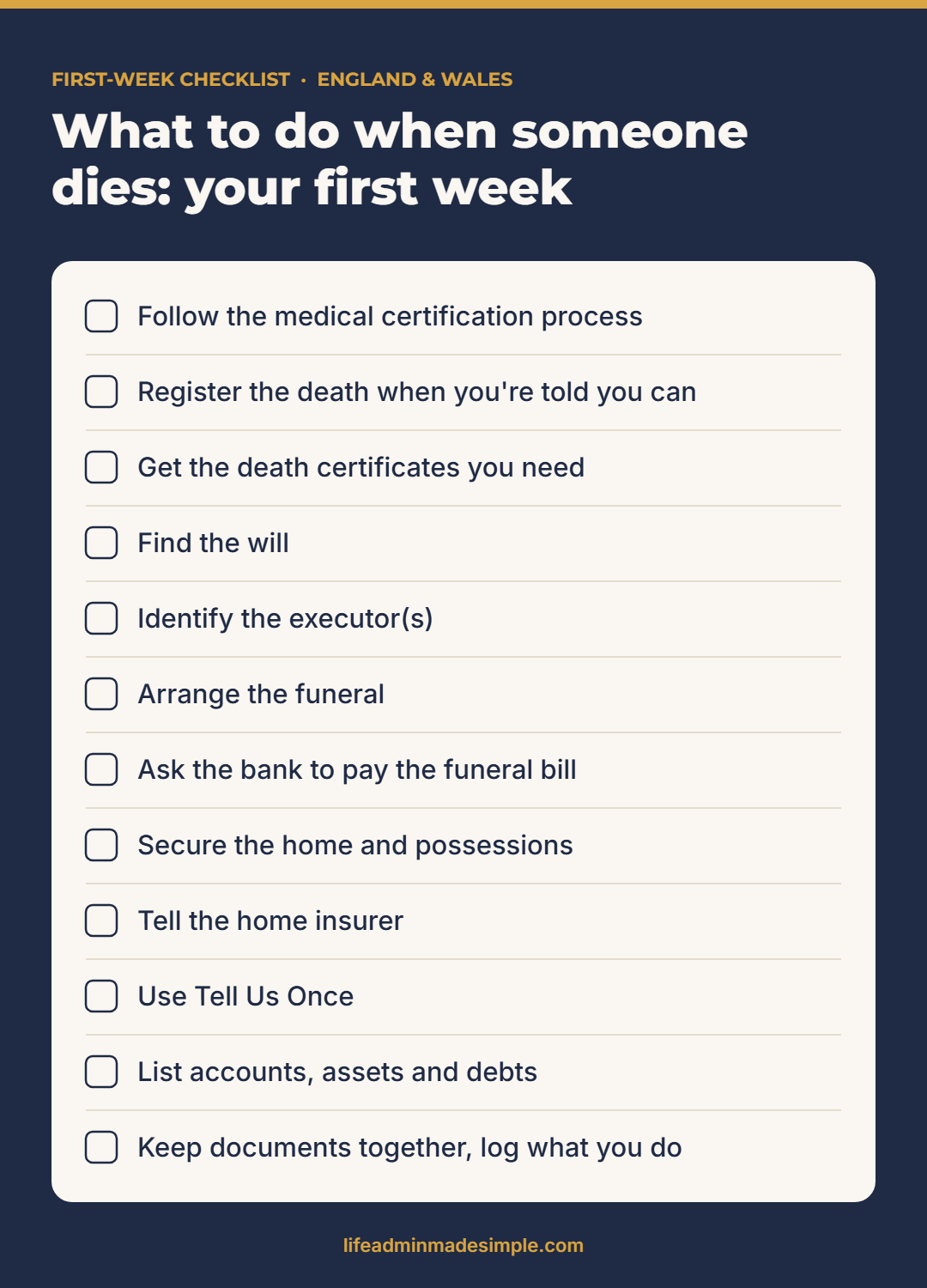
Everything else can follow from there.
When should you get professional help?
Many straightforward estates are administered by the executors themselves. Consider advice from a solicitor, probate practitioner, accountant or tax adviser where there’s:
- a dispute over the will;
- disagreement between executors or beneficiaries;
- a trust;
- substantial lifetime gifts;
- overseas property or investments;
- a business;
- significant pension savings, especially for deaths from April 2027;
- a complicated Inheritance Tax position;
- doubt about whether a will is valid;
- an unmarried partner or dependant who may have been left out;
- an estate that may not cover its debts; or
- uncertainty about who is entitled to administer or inherit.
Getting advice on one difficult issue doesn’t mean handing the whole estate to a professional.
Frequently asked questions
How soon after someone dies do I need to register the death?
In England and Wales, within five days of the medical examiner’s office confirming that you can register it. Different rules apply when a coroner is involved.
Do I need probate when someone dies?
Not always. It depends on what’s in the estate and on the rules of the organisations holding it. Jointly owned assets may pass automatically to the surviving owner, and some banks release smaller balances without probate. Property in the person’s sole name almost always needs it.
When does Inheritance Tax have to be paid?
By the end of the sixth month after the death. HMRC charges interest on late payment, and most of the tax usually has to be paid before the probate grant is issued.
What is the difference between an executor and an administrator?
An executor is appointed by a will. An administrator deals with an estate where there’s no executor able to act, usually because there’s no valid will. Both are personal representatives responsible for administering the estate.
Do I have to use a solicitor for probate?
No. You can apply for probate yourself in England and Wales. Professional help is worth considering where an estate is complicated, disputed or raises difficult tax or legal questions.
Are an executor and a beneficiary the same thing?
Not necessarily. An executor administers the estate. A beneficiary receives something from it. The same person can be both.
Do I inherit someone’s debts when they die?
No. Debts are paid from the deceased person’s estate. They don’t become the personal debts of relatives or beneficiaries. The exceptions are debts you were jointly liable for, such as a joint loan or a debt you guaranteed, so get advice if the position is unclear.
What happens if there is no will?
The estate is administered under the intestacy rules. An eligible relative can apply to become administrator, and the law decides who inherits. An unmarried partner receives nothing automatically.
Official guidance
This guide is meant to make the process easier to understand. Official government guidance always takes precedence. Useful official resources:
- GOV.UK: What to do when someone dies
- GOV.UK: Register a death
- GOV.UK: Tell Us Once
- GOV.UK: Bereavement Support Payment
- GOV.UK: Inheritance Tax
- GOV.UK: Applying for probate
- GOV.UK: Dealing with the estate of someone who’s died
Written by Rob, Life Admin Made Simple
Scope: England and Wales
Last reviewed: 5 October 2026
Rob set up Life Admin Made Simple after acting as executor for a family member and years spent handling charity administration. He writes plain-English guides and tools to help families in England and Wales get through the admin after a death, checking every guide against current GOV.UK guidance.
Life Admin Made Simple provides practical information and organisational tools, not legal, financial or tax advice. Rules and individual circumstances vary. Check current official guidance and consider professional advice where appropriate.